How It All Began
(2005) I decided to go ahead and share the initial incorporation paperwork, for a couple reasons.
The following is that paperwork.
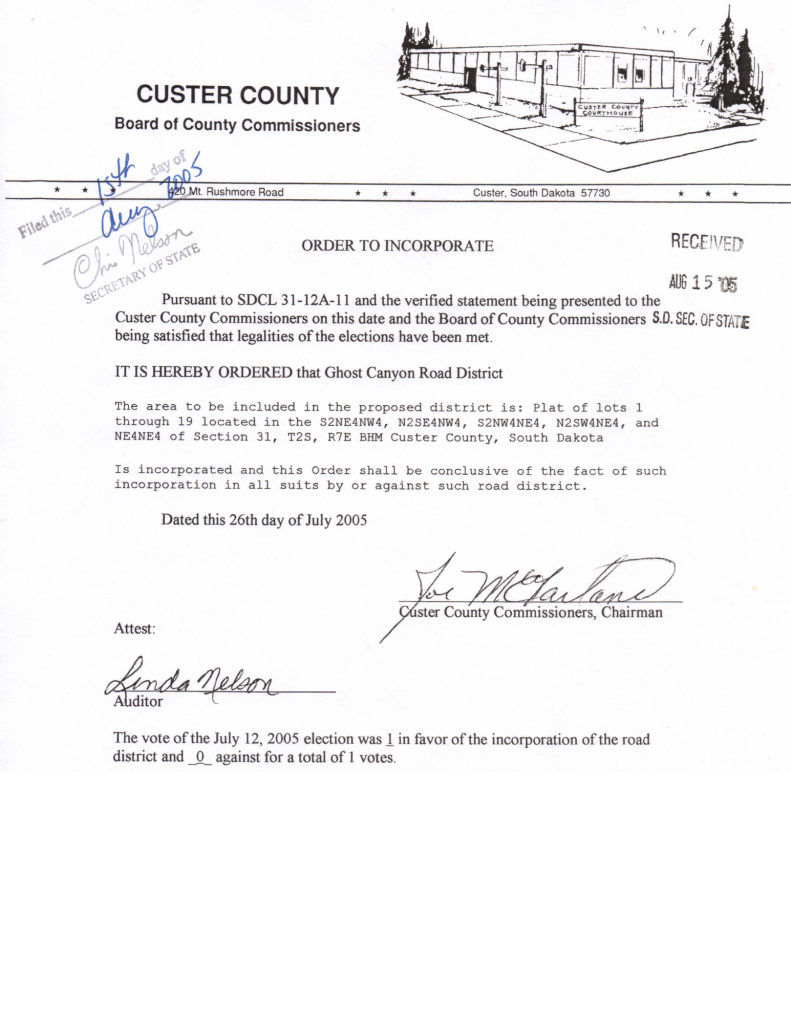
Now I still am not completely certain if this was a legal filing for a couple reasons. One is that I looked through files with the registrars office and talked with a couple people who were around before this was created, and there were people living on this road, when this happened.
However, the election paperwork in the file at the auditors office, shows one vote. The vote of the developer. I am still looking into this part, but I now think that perhaps some corners were skirted.
However, this is a topic for another post. What I want you to take notice of here is the date. The road district was started July 26, 2005.
When my brother and I bought on Concho, we were provided with CC&rs. We were really trying to find property without covenants but just could not find one. When we were shown this place, we got a copy of the CC&Rs and looked through them and had a lawyer friend look at them. I’ll include part of them here when I dig them up and scan them.
What is of interest is that they were written prior to the date on the above incorporation papers. Yet, they mention a $200 annual road association fee. I feel this is an issue because the road association and the road district, have to be two different things.
Also, the $200 annual fee cannot therefore be a ‘levy.’ It is simply a road association fee, like an HOA fee, but for the road. As this fee was in the CC&Rs which include several neighborhood concerns, like having horses or what size your house must be, it had nothing to do with the incorporation of a road district.
When the Barkers and Amundsons and whoever, ‘activated’ the road district, they were possibly working from a faulty assumption, which worked in their favor but against those of us who were actually legal landowners in the district.
They did not live in the same ‘neighborhood’ as those of us who were legal landowners, therefore legal district members and legal voters. They lived in Ghost Canyon Subdivision II, whereas it appears the road district only covered or included Ghost Canyon Subdivision I.
The fee they made a motion from the floor and resolution for, which they had absolutely no legal right to start, was unlawful immediately. A road district can either impose a levy or a special assessment or both… but they cannot just charge everybody the same fee. That is neither a lawful special assessment nor a levy.
I know I get into this later, but let me touch on it here.
A levy is based on the property value. So, unless every single property had the exact same value, the levy could not possibly be the same for each property.
In order to help better explain this, I’ll provide some info from the South Dakota Municipal League. While Road Districts are not municipalities, they do have to follow SDCL 9-43, when imposing a special assessment, which was written for municipalities. Still with me? Yeah, I had some trouble with this when I first started, but after a while these laws make more sense. SDCL 9-43 is long and cumbersome. The SD Municipal League breaks it down nicely:
Special assessments may be used for local improvements, which are defined as:
“The process of building, altering, repairing, improving, or demolishing any local infrastructure facility, including any structure, building, or other improvement of any kind to real property…”
This clarifies that special assessments are not for maintenance or repair, but only improvements. For repair and maintenance, a levy would be used. This is commonplace. We see this same sort of procedure in most states and talked about most often in regards to HOAs. A great deal of the caselaw or opinions I found concerned HOAs, but still pertains to entities such as Road Districts or other political subdivisions.
Special assessments may be used to assess the amount equal to the special benefit received by property specially benefitting from the local improvements after an investigation by the governing body to determine the amount of benefit from construction of the local improvement to the lots and tracts fronting or abutting the improvement (SDCL 9-43-78 and 9-43-79).
This guide can be found here. I reference it a lot. It just takes the legalese of the SDCL 9-43 and makes it easier to understand. Even a lawyer could understand it.

What I’m saying here is that the $200 annual fee was neither a special assessment nor a levy. Nor did it have anything to do with the Road District incorporated in 2005. They were and continue to be completely different things.
When the interlopers unlawfully took control of a road district they did not own property in and created a taxing scheme that was not legal even if they had been legal landowners, they started the pattern of wanton disregard for the law. A pattern that continues to this day.