‘Everyone is Welcome’
If only that were true. This is the board that actually wrote bylaws to keep qualified people from running for a board position. Like so many of the bylaws, this one too was unlawful, as it contradicts state law.
Here it is:
Section 4.1 – Membership: All landowners of record of any real property lying within the described boundaries of the Saddleback Road District shall be considered members eligible to vote and participate in the affairs of the Road District.
Section 4.1.1 – Membership Eligible Voter: An owner of land within the road district is entitled to only one vote in road elections regardless of the number of parcels of land owned within the district. † per SD Attorney General Opinion No. 23-03
Section 4.1.2 – Membership Good Standing: An owner of land within the SBRD is in Good Standing when; the SBRD annual flat per landowner tax levy in Special Assessment District 113,due annually on or before April 30th and collected by the Custer County Treasurer in the current or any previous year, is/(are) not currently delinquent.
Section 6.2– Election of Officers: Future Trustees shall serve three (3) year terms upon their election in accordance with the provisions outlined in SDCL 31-12A-16. Nominees for each Trustee officer position shall meet the qualification standard for an active Trustee to serve in that office: Saddleback Road District Bylaws amended May 6th,2025
- Section 4.1.2 membership in good standing,
- No history of actions that intended to cause harm to SBRD operations,
- No actions/activities which present a conflict of interest,
- The ability of such perspective officer to perform duties in accordance with applicable statutes, bylaws, and procedures.
The problem?
Our road district’s bylaws say you’re only in “good standing” (and can vote or run for trustee) if you’ve paid the annual $500 flat fee (what they call a “tax levy” or “special maintenance fee”). If you’re behind—even if you think the fee itself isn’t legal—you’re out. No vote at the annual meeting, no chance to run for the board.
That may sound reasonable at first glance (like “pay your dues”), but it actually clashes with state law. Here’s the simple breakdown:
South Dakota law (SDCL 31-12A-1.2) spells out exactly who gets to vote in road district elections:
Any landowner in the district boundaries. Period. Full stop.
No mention of paying fees, being current on payments, or being in “good standing.” If you own land there, you’re eligible. That’s it.
The law doesn’t give the board or bylaws the power to add extra hurdles like “you must pay this disputed fee first.” Bylaws can set some internal rules (like no conflicts of interest), but they can’t override what the state statute says about who gets to vote or run. Adding a payment requirement basically creates a new restriction the legislature never authorized.
Imagine if a city said “You can only vote in city elections if you’ve paid your water bill.” That wouldn’t fly—voting rights are set by law, not by whether you’ve paid a separate charge. Same principle here.
Even if the $500 fee turns out to be 100% legal (and plenty of us think it’s not, since the statutes only allow value-based taxes or benefit-based special assessments, not flat fees on everyone), the bylaws still overstep by tying your basic rights to pay it.
This setup could discourage people from speaking up, running for office, or even questioning the board—especially if they disagree with how the money’s being spent. In a small district run by neighbors, we should want more participation, not less.
Not exactly a “Everyone is Welcome”.
What do you think? Have you seen this “good standing = paid up” rule used to block votes or candidates? Or oust elected officer? Whether you agree with it or not, it is not lawful.
And let’s not forget these are the same people who wrote this bylaw-
Section 6.11 – Removal of Officers: Trustees must maintain Section 4.1.2 membership in good standing throughout their term or be removed or resign from office . Any Trustee/officer may be removed for cause, by a majority vote of the Trustees at a meeting of Board members. Cause includes actions by a Trustee that cause harm to SBRD operations, resulting in a conflict of interest, or the inability of such Trustee/officer to perform duties in accordance with applicable statutes, bylaws, and procedures.
The South Dakota Legislature has already established the rules for when and how a public office becomes vacant, and for how removal from office can occur for local officers. Road district trustees are elected public officers of a governmental subdivision (§ 31-12A-12), so those rules apply.
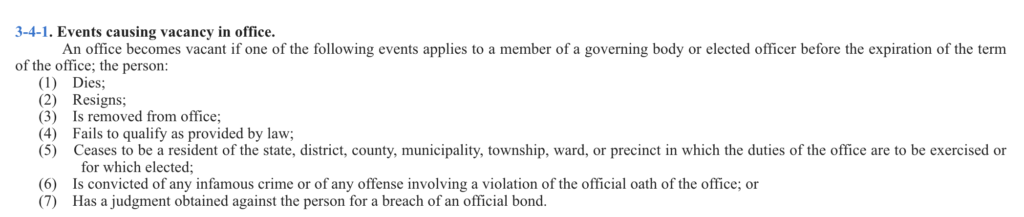
- Chapter 3-4 lists the exclusive events that cause a vacancy (death, resignation, removal from office, failure to qualify, loss of residency, felony conviction, incompatible office, etc.). Bylaws cannot add new events to that list, such as “failure to pay the special maintenance fee” or “not in good standing per our definition.”
- Chapter 3-17 provides the actual procedure for removal when one of the serious grounds in § 3-17-6 exists (misconduct, malfeasance, nonfeasance, crimes in office, violation of oath). That procedure is not an internal board majority vote at a regular meeting. It is a formal proceeding brought by the state’s attorney in the name of the state, with notice, the right to defend, evidence, and a judicial-style determination.
The board cannot bypass this statutory framework by writing a bylaw that says: - “We can remove you by majority vote for ’cause’ (which we define to include not paying our fee).”
- “You must stay current on the fee or be removed or forced to resign.”
That directly contradicts state law in two ways:
- It invents a removal power and process the statutes do not grant to the board.
- It adds a vacancy-causing condition (fee delinquency) that is not among the events listed in § 3-4-1 or the grounds in § 3-17-6.
A bylaw is subordinate to statute. It can fill in procedural details where the law is silent, but it cannot contradict, expand, or circumvent clear statutory limits on who can hold office, how eligibility is determined, or how removal occurs. Doing so makes the provision legally unenforceable if challenged.
In practice, if the board ever tries to use Section 6.11 to remove a trustee over non-payment of the fee:
- The affected trustee could refuse to step down and seek a court declaration that the removal was invalid (declaratory judgment under SDCL ch. 21-24 or quo warranto under ch. 21-28).
- The court would likely look to Chapters 3-4 and 3-17 and find no authority for the board’s action.
- Even if the fee were perfectly legal, the removal mechanism in the bylaws would still be defective.
This is one more example of the bylaws attempting to enforce the disputed flat fee through governance rules that exceed what the law allows. The proper way to address a trustee’s alleged misconduct or nonfeasance (if paying the fee were somehow a duty) would be for the state’s attorney to bring formal charges under Chapter 3-17—not for two board members to vote the third out at a meeting.
Here’s the thing.
The board already has a history of violating state law. This is just another example- by removing an elected trustee (someone WE voted in) with no legal authority to do so. No court, no state’s attorney, no proper process—just the board deciding they didn’t like him and kicking him out.
No one in authority stepped in. No consequences.
Then they doubled down.
At another unlawful meeting (no proper agenda notice, breaking open meetings rules again – something they were publicly reprimanded for), they held a surprise “vote of confidence” for Crystal Farrokhi.
- It wasn’t on the agenda—so it wasn’t legal to vote on it.
- But they did it anyway.
And after all that, the board still says “all are welcome.”
Really?
The same person who helped unlawfully vacate an elected office is back on the board.
This isn’t leadership.
This is untrustworthy behavior.
This is lying about following the rules while breaking them.
This is the Apple Dumpling Gang sans the wholesome, endearing qualities.
We elect trustees to represent us—not to rewrite the law when it suits them, remove people they disagree with, sneak in illegal votes, and then pretend everything’s fine.
If they can ignore state law on removal and open meetings, what else are they ignoring? Our money? Our roads? Our rights?
No, not all are welcome. They are seeking another dumpling. Likely, they are grooming one right now.
This message is for those of you who want to see some honor and integrity put back on the board. These people will continue to collect our money, improve their roads, and answer to no one.
If you are not a dumpling, run for office. Granted Captain Conundrum is counting the votes again, so … you know, ask to see the ballots. You may not remember or know that we used to vote publicly. Granted, it was still corrupted by Crystal who accepted absentee ballots, but at least the BS was more transparent.
Keep in mind that as an elected officer, you do not receive the same protections as private people and you will be mentioned here. Whether you are discussed in a positive or negative light is completely up to you.