Case Law and the First Amendment
I’ve known from the beginning what I could and could not say on this site. If I had something that seemed a bit questionable, I had some people I could ask.
While I have yet to cross that line, I do believe it is a line that should be skirted from time to time, if not jumped over entirely. The First Amendment needs to be exercised to its fullest in order to keep it in proper shape.
The US Supreme Court (SCOTUS) has heard many cases regarding the First Amendment. This amendment is often referred to as the Right to Freedom of Speech, although it covers 4 other rights.
When Law Enforcement makes a statement such as, “yeah… that’s a grey area,” then it really isn’t.
The vagueness doctrine generally requires that a statute be precise enough to give fair warning to actors that contemplated conduct is criminal, and to provide adequate standards to enforcement agencies, factfinders, and reviewing courts.- Cornell Law
A simple search online will provide a basic understanding of what is not protected under the Free Speech clause.
Types of speech that are not protected by the First Amendment include incitement to imminent lawless action, true threats, defamation, obscenity, and fraud. These categories of speech can be restricted or punished under the law.
What SCOTUS continues to affirm is that the freedom of speech and press is a right that we each should hold very dear.
In Gitlow v. New York (1925), the Court stated that “freedom of speech and of the press…are among the fundamental personal rights and ‘liberties’ protected by the due process clause of the Fourteenth Amendment from impairment by the States.”
“The Free Speech Clause’s fundamental purpose is to ensure that public debate is “uninhibited, robust, and wide-open.” This concept is often called the “marketplace of ideas,” a metaphor suggesting that the best way to find truth is to allow all ideas, popular and unpopular, to compete freely in public discourse.
As James Madison argued, in a republic, “the censorial power is in the people over the government, and not in the government over the people.”
The legal standard for when government can restrict inflammatory speech has evolved dramatically over time, reflecting a clear trend toward greater protection. The journey began with controversy over the Sedition Act of 1798, which criminalized “false, scandalous and malicious writing” against the government and was used by the Adams administration to prosecute political opponents.
Though the Supreme Court never ruled on it, the Act was widely condemned as unconstitutional and helped crystallize the “central meaning of the First Amendment” as the right to criticize public officials.” (bold and italics emphasis added). For the rest of this original article, click here.
“…the right to criticize public officials.”
They may not like to be reminded that they are here to serve us, and not vice versa, and the first amendment clarifies that relationship.
So, while Dale Ruzicka can whine and cry….

and do whatever he can to infringe on my first amendment rights, I know better.
This is a 1st Amendment issue, because it is clearly not a harassment issue. If one reads the harassment statute, in the Stalking chapter, all by itself, one might think this has something to do with that.
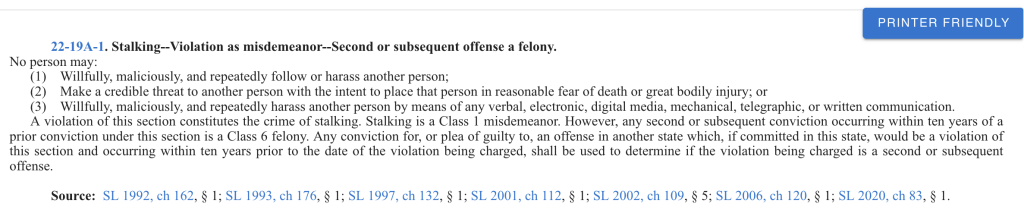
However, that’s not how this works. (This is the statute I believe the Deputy was referring to.)

There has been no direct communication with Dale and there has been zero implication of any harm. While Dale might be annoyed (which he obviously is as much as he talks about this website to everybody who is forced to listen), it does not affect my right to express myself concerning his actions in office.
It’s my opinion, that more than one other person shares with me, that this is something Dale does. He bullies people. He thinks that a deputy making a phone call will knock the wind out of my sails, when actually it is the opposite.
Some may recall a guy in 2018 who didn’t like the deserved attention he was getting on a blog of mine. He filed a complaint at the sheriff’s department and a deputy gave me a call. I told them the complaint he had was civil not criminal. They agreed. That was it for that complaint. This guy then asked a friend in the department to give me a call. I informed that deputy that he was the second one to call me about this, and this was another form of bullying. He apologized and said he was unaware of the previous interaction.
All of this was published on that blog. With names and dates.
He eventually lost his job and within a fairly short time he moved out of state. That blog is still published and still gets traffic from searches for his name. He was another person who threw around the ‘defamation’ accusation a great deal, but it never went anywhere because once again, every single thing I published was fact with documentation.
I’m not a fan of bullies.
I’m not a fan of people trying to roll right over the top of other people.
I’m not a fan of people trying to spin the truth to make it look like they are the victims, when in fact, they are the instigators of the entire saga.
My response to such people is true transparency. I publish everything. I publish unedited documentation. I express myself. And I keep going. I do not bend to bullies.
There will always be those people who want to believe the Dale’s of the world. However, there are others who are watching from the sidelines and are slowly starting to reach out and ask questions. Eyebrows being raised. Links being clicked. Truth getting out.
For you pro-se litigants or activists out there, it takes time. Keep in mind that when the government -which includes elected officers- try to chill your free speech, that’s grounds for a legal action, and you might be surprised how many lawyers want to get involved in a civil rights action.
Learn the law, stand on it… fight back. It’s all we have.